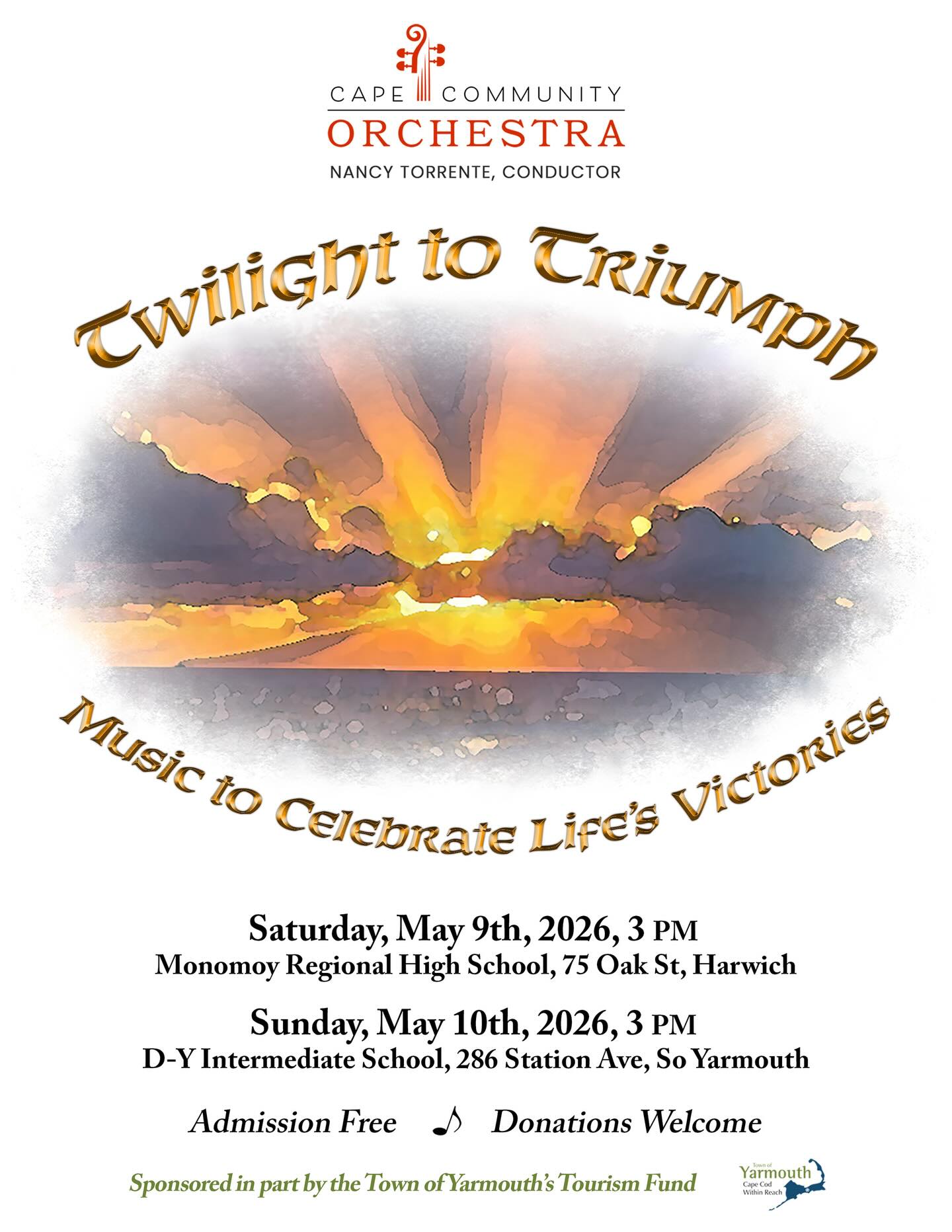
\Cape Community Orchestra, under the direction of conductor Nancy Torrente, presents its spring concerts, “Twilight to Triumph: Music to Celebrate Life’s Victories,” will be held Saturday, May 9, at 3 PM at Monomoy Regional High School, 79 Oak Street in Harwich, and Sunday, May 10, at 3 PM, at Dennis-Yarmouth Intermediate School, 286 Station Avenue in South Yarmouth.
The program includes “Saturday Night Waltz” by Copland, Mahler’s Symphony No. 1, first movement, Dvořák’s Symphony No. 8, first movement, and “Mars” by Holst.
Admission is free (donations are welcome).
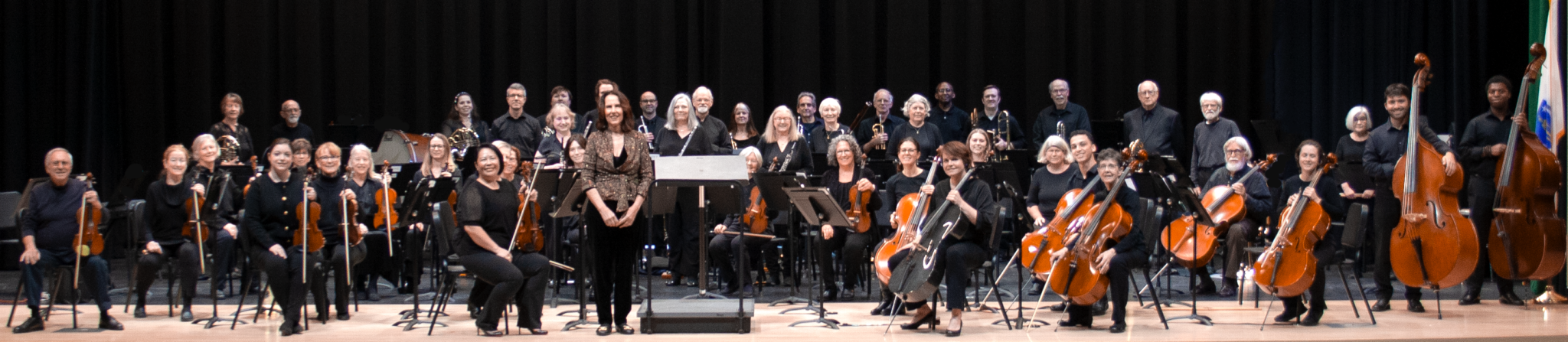
“Saturday Night Waltz” is one of a suite of dances from Rodeo, Aaron Copland’s (1900-1990) celebration of the American West. Commissioned by the Ballet Russe de Monte Carlo, with choreography and scenario by Agnes de Mille, the ballet premiered in 1942 to a wildly enthusiastic audience demanding 22 curtain calls.
The ballet tells the tale of a lovestruck cowgirl who tries to impress the local cowboys, particularly the Head Wrangler by out-wrangling them at the rodeo, but to no avail. The Head Wrangler is more interested in the more winsome visiting city girls. The cowgirl eventually finds happiness with the Champion Roper, who appreciates her true athletic nature.
Copland wove a number of American folk songs in these dances. “Saturday Night Waltz” quotes “Goodbye Old Paint,” expressing the cowgirl’s loneliness through a mournful oboe solo. The waltz is slow and elegant, with an air of down-home simplicity, featuring woodwind solos.
Gustav Mahler (1860-1911) completed his first symphony in 1888, initially referring to it as a symphonic poem or tone poem in symphonic form. Considered a masterpiece today, the work was roundly criticized at its premiere, and Mahler revised it several times over the years.
Mahler titled the first movement, “Spring without End,” and noted that the introduction depicted “the awakening of nature from its long winter sleep.” Featuring birdsong, folk songs, and melodies from his own song cycle, “Songs of a Wayfarer,” the movement opens gently, in the otherworldly still of winter, with a seven-octave drone on A in the strings. Fanfares by clarinets and distant trumpets begin softly. Soon the forest awakens. Nightingales, quails, and cuckoos sing out. The cellos introduce a buoyant
melody as the youthful hero joyfully strolls through nature, the ultimate healer.
The mood grows melancholic though, as the hero senses that his own happiness is not assured. Happiness soon returns, as the horns lead the exuberant final section. Mahler ends the movement with a bit of humor, describing the last few measures: “My hero breaks out in laughter and runs away.”
Antonin Dvořák (1841-1904) composed his Symphony No. 8 (originally published inaccurately as No. 4) over 17 days in 1889 at his bucolic retreat in Bohemia. It is a joyful work, full of appealing melodies expressing his delight in being alive in nature amid the rolling hills and forests. “The melodies simply pour out of me,” Dvořák said.
The symphony draws on Bohemian folk melodies and the sounds of nature, blending European and Eastern European musical styles. The solemn opening theme from the cellos gives way to the pastoral sounds of birds depicted by the flute. The clarinets introduce a darker mood that turns stormy as the trumpets and trombones join in, but the cheerful mood prevails.
The symphony exudes a celebratory, lighthearted, almost childlike, spirit. It was described by conductor Alexander Platt as “a masterpiece of radiant nationalism,” an “utterly joyous, bucolic, pastoral symphony that is full of Slavic-inspired melodies and musical imagery of the beautiful Czech countryside,” where he composed it. Czech conductor Rafael Kubelik, is said to have told an orchestra that “in Bohemia the trumpets never call to battle—they always call to the dance.”
Gustav Holst’s (1874-1934) deep interest in astrology inspired him to compose The Planets, a seven-movement suite (he left out Earth and Pluto, which hadn’t been discovered at the time) that has become his most popular work. The Planets evokes the astrological and mythological character of the planets, rather than their scientific features. Holst completed Mars in 1914, prior to the outbreak of World War I, as a characterization of Mars, the god of war, rather than a response to any particular war. It reflects his discomfort with the increasing mechanization of war. Nevertheless, when war came, he was devastated when his precarious health prevented him from joining the military to help defend England in World War I.
Mars is written in the unusual and uneven time signature of 5/4 (not an easy rhythm to march to) and features a relentless ostinato rhythm initially played by the strings collegno battato, with the wood of the bow, rather than the hair. Dissonant horns and brass loudly portray the ferocious battles of war, and heavy percussion emphasizes the military aggressiveness of new mechanized warfare: machine guns, tanks, and vast armies marching on in triumph.
For more information, visit Cape Community Orchestra.