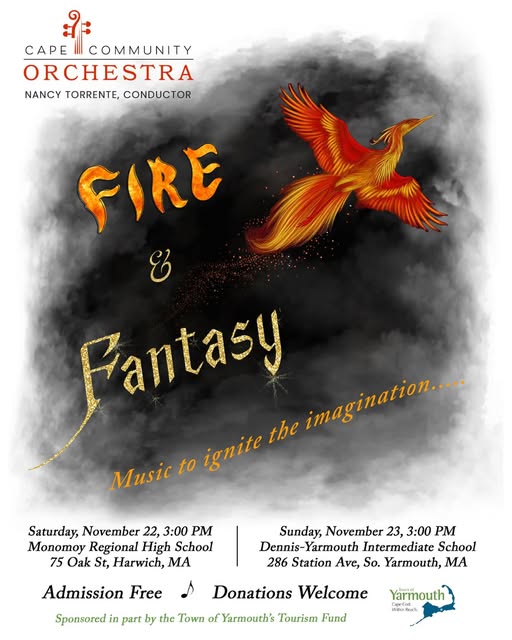
Cape Community Orchestra presents “Fire & Fantasy, a program of music to ignite the imagination” on Saturday, November 22, at 3 PM, at Monomoy Regional High School, 75 Oak St, Harwich, and Sunday, November 23th, at 3 PM at D-Y Intermediate School, 286 Station Ave, So Yarmouth. Doors open at 2:45 PM.

Nancy Torrente conducts this program of orchestra classics and cinematic scores, appealing to all ages. All concerts are free, although donations are gratefully accepted at the door.
Overture for Music for the Royal Fireworks, George F. Handel (1685-1759), arranged and edited by Thor Johnson
King George I of England commissioned Handel to write Music for the Royal Fireworks to celebrate the signing of the Treaty of Aix-la-Chapelle in 1748, which ended the War of Austrian Succession between the French and the English. The celebration, which was attended by 12,000 people on April 27, 1749, was intended to be a king-sized victory celebration, with over 100 cannons firing salutes, followed by an extensive fireworks show.
King George specifically asked Handel not to include any strings in the work; he wanted only “warlike instruments.” Reluctantly, Handel agreed to compose for a loud and fierce military band. It is estimated that the performance included 50 to 100 musicians: 24 oboes, 12 bassoons, contrabassoon, nine horns, nine trumpets, and six timpani. (Shortly after the performance Handel performed the work again, this time as he preferred it, with a full complement of strings and fewer wind and brass instruments.)
The Overture begins with a slow and stately grand introduction in a martial and celebratory style, featuring dotted rhythms and fanfares. An energetic Allegro follows, with quick exchanges between brass, winds, and strings. The timpani contributes to the massive sound.
At the 1749 premiere, the Overture was to be followed by cannon fire, alternating with the remaining five movements of the suite, and followed by the biggest fireworks display ever mounted. Unfortunately, the fireworks machine exploded, and a huge conflagration ensued. Handel’s music, however, was a great success and remains one of his most popular works.
Ritual Fire Dance, Manuel De Falla (1876-1946)
Ritual Fire Dance is the most famous of 13 movements of de Falla’s ballet El Amor Brujo (Love Bewitched), which premiered in Madrid in 1915. The ballet conveys the gypsy folk legend of the beautiful Candela, who is in love with Carmelo, the bullfighter. Unfortunately, the ghost of Candela’s first husband, a cruel man she did not love, haunts her, preventing her from approaching Carmelo. Her solution is sorcery. One night, at midnight, the gypsies encircle their campfire and Candela performs the Ritual Fire Dance, causing the ghost to appear. She dances with him, whirling faster and faster until he is enticed into the fire, disappearing forever.
The fiery, passionate, mesmerizing music captures the excitement of an Andalusian folk dance. One of Spain’s leading composers, de Falla made good use of Spanish rhythms, folksongs, and folk-like melodies. The piece features many fast trills, ornaments, and lively rhythms. Though the ballet itself was not considered successful, the Ritual Fire Dance remains a much-loved favorite.
Asturias, Isaac Albéniz (1860-1909), transcribed and arranged by Victor López
A piano virtuoso, Albéniz was one of the most influential composers in Spanish music history. Though he spent much of his life traveling through Europe and the Americas, he was known for incorporating his native folk music into his works.
Albéniz composed Asturias for the piano, masterfully incorporating the style of flamenco guitar playing. It was later transcribed for the guitar and made famous by classical guitarist Andrés Segovia. The work received its name when it was republished after his death, just before World War I. It’s a misnomer, however, as it is the southern Spanish region of Andalusia that is known for flamenco music, rather than the northern coastal region of Asturias.
Orpheus in the Underworld Overture, Jacques Offenbach (1819-1880), arranged by Carl Binder (1816-1860)
Offenbach’s Orpheus in the Underworld is a comic opera parodying the tragic Greek myth of Orpheus and Euridice, upon which Christoph Willibald Gluck’s opera Orfeo ed Euridice (1762) was based. Irreverent and witty, it was also seen as a satire on Napoleon III’s court and government. In Offenbach’s tale, Orpheus, a mediocre music teacher, and Euridice are unhappily married and involved with other lovers. When Euridice flies to the Underworld with Pluto, Orpheus is relieved, but forced, by Public Opinion (a character in the opera) to try to retrieve her. Orpheus uses his musical skills to save his wife, but, in the end, loses her again when he looks back at her when they are leaving: a happy ending for both.
Orpheus in the Underworld premiered in 1858 with only a prelude as an introduction. The famous Overture was actually composed in 1860 for a performance in Vienna by Austrian musician Carl Binder, who compiled it using pieces of music from the opera.
The Overture includes a powerful fanfare, a tender love song played on solo clarinet, and a dramatic passage representing the descent into Hades, but it is best known for its wildly energetic “Galop infernal,” a Bacchanalian frenzy depicting an orgy of the gods in Hades. The tune was later adopted by Parisian cabarets to accompany the scandalous can-can dance and has been known as the can-can ever since.
The Firebird Suite: Berceuse and Finale, Igor Stravinsky (1882-1971), arranged by Merle J. Isaac
Stravinsky was Sergei Diaghilev’s third choice to write the music for his new ballet, The Firebird, when other composers did not work out. A student of Rimsky-Korsakov, Stravinsky was, at the time, young (27) and relatively little-known. But he was enthusiastic and collaborated directly with the choreographer, creating a dazzling score that catapulted him to international fame.
Diaghilev’s intent was to create a ballet as Russian as possible, as all things Russian were quite popular in Paris, where the ballet premiered in 1909. The story brings together the most famous characters from a number of Russian fairytales, including the Firebird, Prince Ivan-Tsarevich, thirteen dancing princesses, and the evil sorcerer-king, Kashchey the Deathless, as well as an excerpt from a famous poem by Yakov Polonsky.
Briefly, Prince Ivan captures and releases the Firebird, who gives him a magical feather. He comes upon 13 young princesses, dances with them and falls in love with the youngest and most beautiful one. He is determined to release them from their captivity by the evil Kashchey. With the help of the Firebird, he succeeds.
The ballet uses exotic music to represent supernatural characters and folk song elements to represent humans. The Berceuse is a gentle, mesmerizing lullaby that puts Kashchey to sleep, and the finale is an exuberant celebration of freedom.
Lord of the Rings: The Fellowship of the Ring, Howard Shore (1946- ), arranged by John Whitney
Canadian composer Howard Shore has written the scores for over 80 films, most notably The Lord of the Rings and The Hobbit trilogies, winning three Academy Awards for Lord of the Rings. The Fellowship of the Rings is considered to be his greatest success.
Based on the books by J.R.R. Tolkien, The Lord of the Rings follows hobbit Frodo Baggins and eight assorted companions on their journey to destroy the powerful One Ring in order to save Middle-Earth from the Dark Lord Sauron.
Shore’s score captures the epic nature of the film—its sweeping vistas, the grand journey, and dramatic battle scenes and provides distinct musical motifs for its unconventional characters: hobbits, dwarves, elves, orcs, and men. Whitney’s arrangement includes several themes and transitions between them: the “Fellowship Theme,” featuring a quick triple meter and soaring trumpet melody; “The Prophecy,” expressing a mysterious and somber mood; the mischievous “Concerning Hobbits,” and the wistful “In Dreams.”
 Notes on The Arts