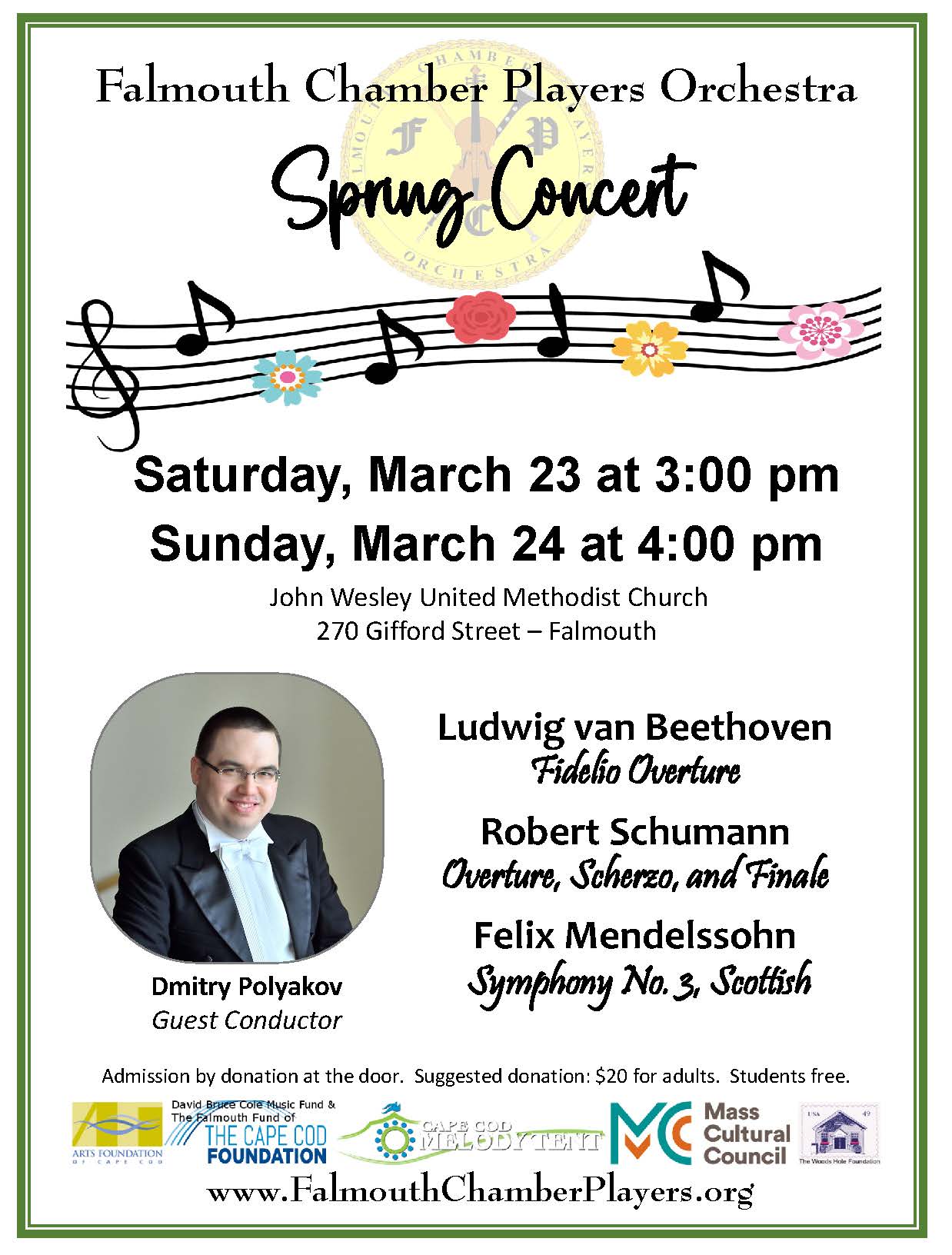
The Falmouth Chamber Players Orchestra, under the direction of guest conductor Dmitry Polyakov, will present its spring concerts on Saturday, March 23, at 3 PM, and Sunday, March 24, at 4 PM, at John Wesley United Methodist Church in Falmouth.
Bass player Beth Giuffrida is happy to be performing under Polyakov’s leadership. “It is inspiring to experience and share in Dmitry’s enthusiasm and infectious joy for the music. His humor adds a light touch to the tougher spots.”
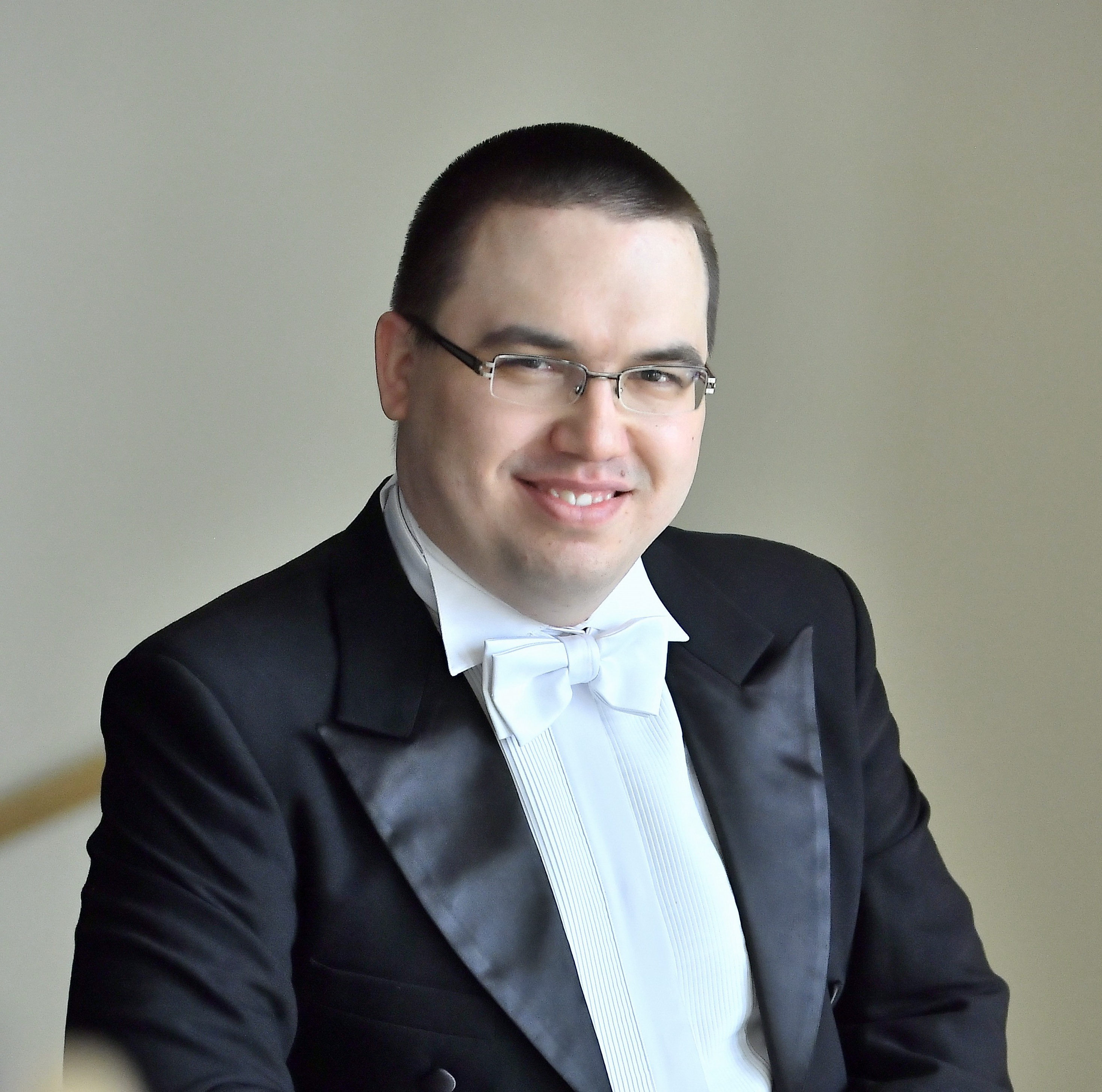
Polyakov is equally excited to be conducting the FCPO. “It is my pleasure to welcome the residents of Falmouth and all surrounding Cape Cod communities to this concert. I am delighted to be preparing an exciting program of classical music masterpieces with the wonderful musicians of the FCPO, who are showing tremendous enthusiasm in the rehearsal process.”
Described as a visionary artistic leader and interpreter of classical music masterworks across all genres, Polyakov has conducted numerous prominent orchestras in a variety of countries, including the Moscow Philharmonic Orchestra, Brandenburg State Orchestra, and Castello Symphony Orchestra. He has participated in many music festivals and projects and holds two master’s degrees from the prestigious Moscow Conservatory.
Violinist Deborah Bradley describes Polyakov as “energetic, exacting, and demanding. We have had amazingly productive rehearsals. He is attentive to every detail of the music, bringing this community orchestra to a higher level of musicianship and artistry.”
Cellist Judy Donn agreed, “It is so satisfying that when Dmitry asks more of us, we really can and do give more, really making music.”
Fidelio, Ludwig van Beethoven’s only opera, tells the story of Leonore, a brave and devoted young woman who risks her life to save her husband, Florestan, a political prisoner, from being put to death. Loosely based on a true story, Fidelio has been described as a “rescue drama,” popular at the time, but it is particularly significant in that it expresses two of Beethoven’s most deeply held beliefs: the importance of opposing political injustice and the ideal of romantic love.
Beethoven worked and reworked Fidelio over a period of 12 years, finally premiering it in 1814. This overture is the fourth he completed during that time. Though it does not echo the melodies of the opera itself, it conveys its emotions: unwavering determination, tension, and a triumphant finale.
“Fidelio is exciting and fun to play,” said Giuffrida, “and the works by Mendelssohn and Schumann are filled with emotion that is gratifying to both the performer and the audience.” Violinist Kathleen Chane added, “it is a joy to play these major orchestra works with an orchestra of this caliber.”
Robert Schumann composed Overture, Scherzo, and Finale in E Major, Op. 2,in a celebratory mood the year after his marriage in 1840 to Clara, presenting it to her on her 22nd birthday. The work, a symphony without a slow movement, is considered to be among Schumann’s greatest orchestral works. The Overture is buoyant, graceful, and delicate, the Scherzo is spirited, with a lyrical trio section, and the fast and fugal Finale builds to a glorious conclusion.
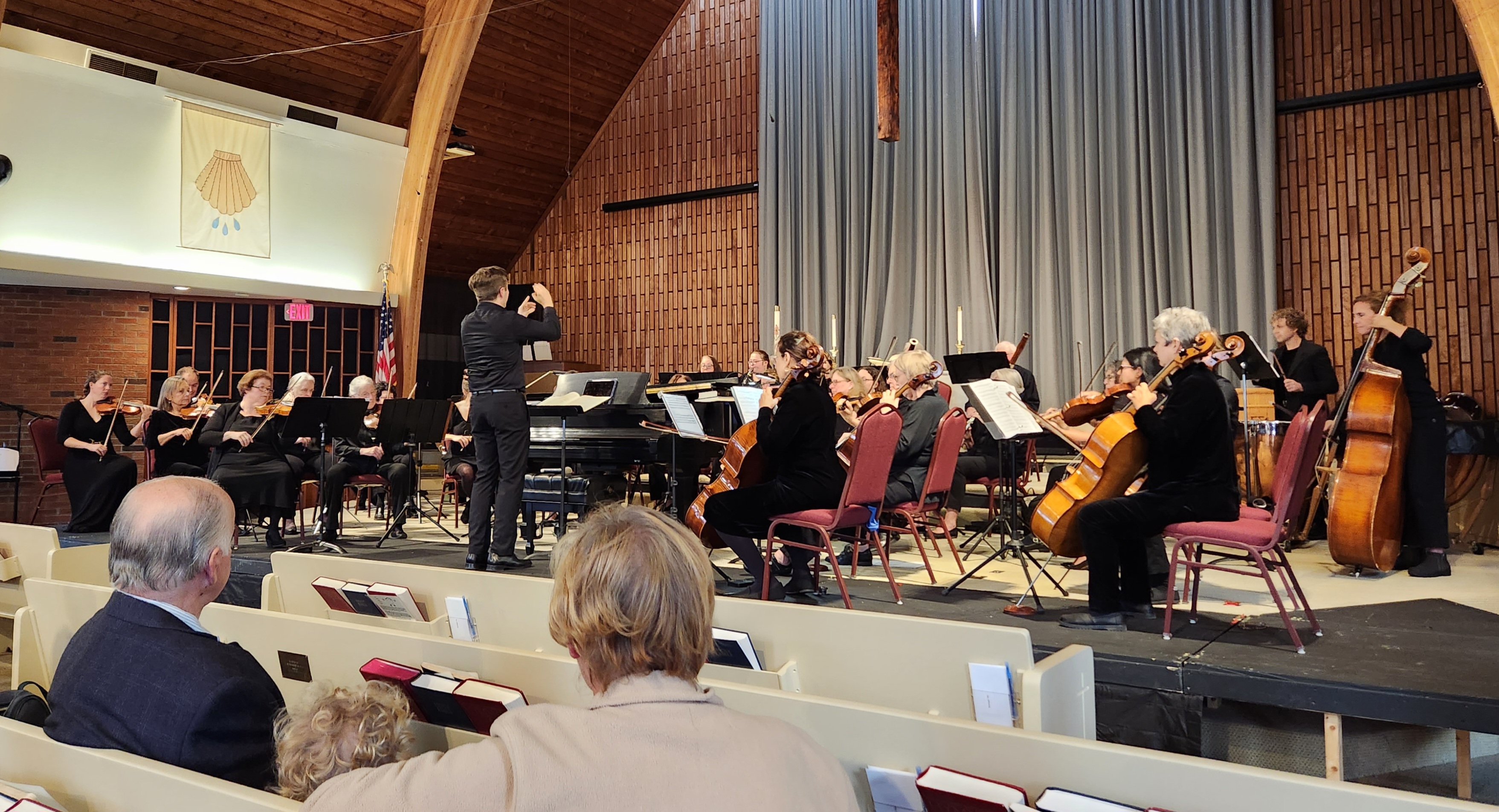
Felix Mendelssohn completed his Symphony No. 3 in A minor, Op. 56, the Scottish (actually his fifth and final symphony) in 1842, inspired by a three-week trip he took to Scotland in 1829. Though it took him some years to “find his way back to the Scottish fog mood,” he was ultimately successful in conveying the dark and brooding nature of the harsh and “comfortless” landscape and the country’s turbulent history, including allusions to Mary Queen of Scotts whose “broken and moldering” Holyrood Palace left a deep impression on him.
The symphony, one of Mendelssohn’s most celebrated works, begins in a solemn manner, evoking the “mists and melancholy” and the grandeur of Scotland, followed by a playful second movement, suggesting Scottish folk dances. The third movement, Adagio, is tender and tranquil, drawing on the romantic appeal of the country, perhaps a lament for Mary. The symphony ends with an exhilarating final movement.
A donation of $20 for adults is suggested, with free admission for students. Tickets are available only at the door. For more information about the concert and the Falmouth Chamber Players Orchestra, visit falmouthchamberplayers.org.
The FCPO is funded in part by the Falmouth Cultural Council, the Mass Cultural Council, the Falmouth Fund of the Cape Cod Foundation, Cape Cod Melody Tent, and the Woods Hole Foundation.
 Notes on The Arts